
 Image 1 of 1
Sound Baths
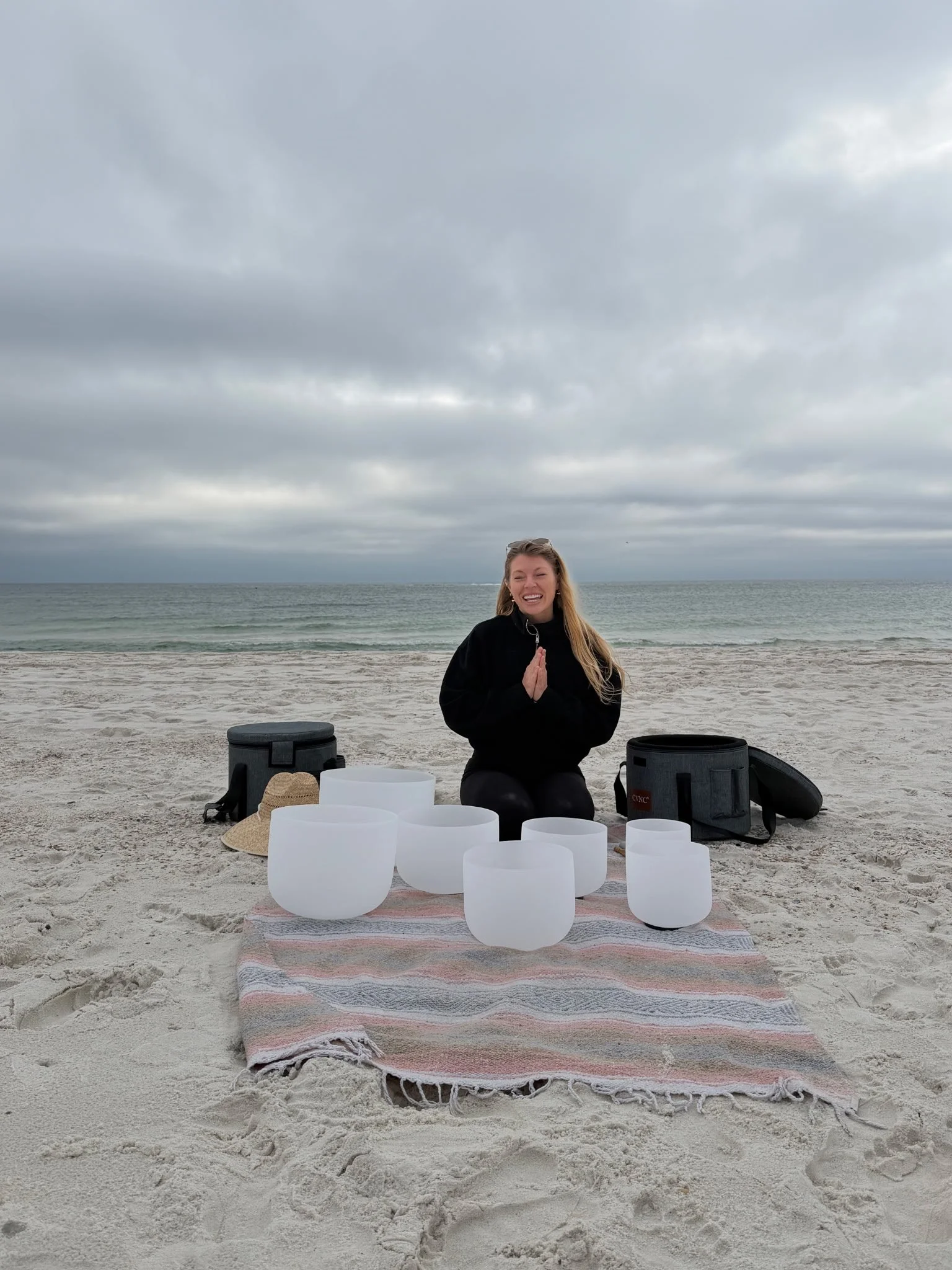
A sound bath is a guided, lying-down meditation where you're "bathed" in layered tones from singing bowls and other resonant instruments. There's nothing to do and no way to get it wrong. You settle onto a mat, close your eyes, and let sound and vibration move through you. Most people describe it as the deepest rest they've had in months: a quiet mind, a heavy body, and a soft landing back into the day. No yoga experience required.
For the science-curious: What's actually happening inside a singing bowl
One bowl, many notes
Every bowl sings a fundamental, its lowest and strongest tone, plus a stack of overtones ringing above it. Bigger, thicker bowls sit lower: a large bowl can hum around 100–130 Hz while its overtones shimmer past 2,000 Hz. That layering is why one bowl sounds so full.
The "wah-wah" pulse
No hand-hammered bowl is perfectly symmetrical, so its main tone splits into two almost-identical frequencies, say 104.3 and 105.4 Hz. They interfere and create a slow pulse equal to the difference, here about 1 Hz. These "beats" often land between 1 and 8 Hz, the same range as our slowest brainwaves.
Struck vs. sung
Strike a bowl and many vibration modes ring at once, like a bell. Circle the rim with a leather mallet and the bowl "locks in" to its fundamental and harmonics for a long, sustained hum. Fun fact: add water and the pitch drops, and the surface dances with tiny standing waves.
Brainwave cheat sheet
Delta · under 4 Hz · Deep, dreamless sleep
Theta · 4–8 Hz · Meditative, dreamy, drifting
Alpha · 8–13 Hz · Calm, relaxed awareness
Beta · 13–30 Hz · Busy, focused, everyday mind
Gamma · 30+ Hz · Fast processing, peak focus
Research cards
UC San Diego · 2017
In a study of 62 adults published in the Journal of Evidence-Based Complementary & Alternative Medicine, participants reported significantly less tension, anger, fatigue and depressed mood after a singing bowl meditation, and a rise in spiritual well-being. First-timers saw an even bigger drop in tension than experienced meditators.
Body signals
Earlier research, including a randomized crossover study that added a Himalayan singing bowl to a guided relaxation session, measured drops in blood pressure and heart rate: signs of the "relaxation response," the body's counterbalance to fight-or-flight.
Brainwaves · 2023
An EEG study played a bowl whose beats pulsed at 6.68 Hz and found listeners' brain activity synchronized at that same frequency, which sits right in the theta range linked to meditation and deep relaxation.
The big picture · 2025
A systematic review of singing bowl research found studies reporting reduced anxiety and depressive symptoms, better well-being, and higher heart rate variability, a marker of a resilient nervous system. The authors also note the research is still young and calls for larger trials.
The honest note on 432 Hz
You'll see 432 Hz all over the internet. A few small studies have found slight differences: in one 2025 trial, heart rate dropped a median 3 beats per minute at 432 Hz versus 1 at 443 Hz. But the research is early and mixed. What's well supported is simpler: slow, sustained, resonant sound helps the body downshift into rest. Sound baths are a beautiful complement to your wellness, never a replacement for medical care.